Difference between revisions of "Rituals by Cees Nooteboom"
(Created page with "{{infobox |title=Rituals |author=Cees Nooteboom |reviewer=C E Stanway |genre=General Fiction |rating=5 |buy=Yes |borrow=Yes |isbn=978-1782067177 |pages=160 |publisher=MacLehos...") |
|||
| (2 intermediate revisions by the same user not shown) | |||
| Line 1: | Line 1: | ||
| − | {{ | + | {{infobox1 |
|title=Rituals | |title=Rituals | ||
|author=Cees Nooteboom | |author=Cees Nooteboom | ||
| Line 11: | Line 11: | ||
|publisher=MacLehose Press | |publisher=MacLehose Press | ||
|date=July 2013 | |date=July 2013 | ||
| − | |||
| − | |||
| − | |||
| − | |||
|summary=Directionless Inni confronts the mysteries of the universe in the Amsterdam of the 1950s, 1960s and 1970s. | |summary=Directionless Inni confronts the mysteries of the universe in the Amsterdam of the 1950s, 1960s and 1970s. | ||
| + | |cover=Nooteboom_Rituals | ||
| + | |aznuk=1782067175 | ||
| + | |aznus=1782067175 | ||
}} | }} | ||
''Rituals'' introduces us to Amsterdam, and to Inni, firstly in 1960, then in 1950, and then in the 1970s. When we first meet Inni, it is when he is a middle-aged man in 1960. Far from responsible and hard-working, we see him as someone who is impulsive and reckless, even to the point of cruelty to his wife - who formulates plans to leave him. It is only after this frankly miserable first impression that we meet the younger Inni, and we see how a chance meeting with a man called Arnold Taads had changed the course of his life. Taads is a man obsessed with matriculating his life down to the last second, letting time dictate what he can do, with whom he can do it with, and, most importantly, when. In Part three, in another chance meeting, the now ageing Inni meets Taads' son, Phillip. Phillip, though having never met his father, curiously lives a life that is an echo of his father's; though as Arnold isolated himself in the mountains, Phillip isolates himself in meditation and the methodology of the tea ceremony. | ''Rituals'' introduces us to Amsterdam, and to Inni, firstly in 1960, then in 1950, and then in the 1970s. When we first meet Inni, it is when he is a middle-aged man in 1960. Far from responsible and hard-working, we see him as someone who is impulsive and reckless, even to the point of cruelty to his wife - who formulates plans to leave him. It is only after this frankly miserable first impression that we meet the younger Inni, and we see how a chance meeting with a man called Arnold Taads had changed the course of his life. Taads is a man obsessed with matriculating his life down to the last second, letting time dictate what he can do, with whom he can do it with, and, most importantly, when. In Part three, in another chance meeting, the now ageing Inni meets Taads' son, Phillip. Phillip, though having never met his father, curiously lives a life that is an echo of his father's; though as Arnold isolated himself in the mountains, Phillip isolates himself in meditation and the methodology of the tea ceremony. | ||
| Line 27: | Line 26: | ||
Thus - Nooteboom has made the plot of Rituals symmetrical. He has given it the ultimate order out of chaos. Perhaps Nooteboom is trying to suggest some theological irony that goes beyond the novel's pages. Indeed, Rituals does possess discourse on religion - as well as art, the economy, family, Amsterdam, sex, loneliness. It is evidence of Nooteboom's mastery that such a brief book contains such a small, yet perfectly structured universe. Highly recommended. | Thus - Nooteboom has made the plot of Rituals symmetrical. He has given it the ultimate order out of chaos. Perhaps Nooteboom is trying to suggest some theological irony that goes beyond the novel's pages. Indeed, Rituals does possess discourse on religion - as well as art, the economy, family, Amsterdam, sex, loneliness. It is evidence of Nooteboom's mastery that such a brief book contains such a small, yet perfectly structured universe. Highly recommended. | ||
| − | For more from Nooteboom, have a look at [[The Foxes Come At Night And Other Stories by Cees Nooteboom and Ina Rilke|The Foxes Come At Night And Other Stories]]. | + | For more from Nooteboom, have a look at [[The Foxes Come At Night And Other Stories by Cees Nooteboom and Ina Rilke (Translator)|The Foxes Come At Night And Other Stories]] and [[In The Dutch Mountains by Cees Nooteboom|In The Dutch Mountains]]. |
| − | {{amazontext|amazon=1782067175}} | + | {{amazontext|amazon=1782067175}} |
| + | {{amazonUStext|amazon=1782067175}} | ||
| + | |||
{{commenthead}} | {{commenthead}} | ||
Latest revision as of 15:01, 3 September 2020
| Rituals by Cees Nooteboom | |
|
| |
| Category: General Fiction | |

| |
Reviewer: C E Stanway
 | |
| Summary: Directionless Inni confronts the mysteries of the universe in the Amsterdam of the 1950s, 1960s and 1970s. | |
| Buy? Yes | Borrow? Yes |
| Pages: 160 | Date: July 2013 |
| Publisher: MacLehose Press | |
| ISBN: 978-1782067177 | |
|
Share on: | |
|
| |
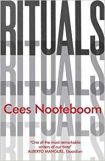

Rituals introduces us to Amsterdam, and to Inni, firstly in 1960, then in 1950, and then in the 1970s. When we first meet Inni, it is when he is a middle-aged man in 1960. Far from responsible and hard-working, we see him as someone who is impulsive and reckless, even to the point of cruelty to his wife - who formulates plans to leave him. It is only after this frankly miserable first impression that we meet the younger Inni, and we see how a chance meeting with a man called Arnold Taads had changed the course of his life. Taads is a man obsessed with matriculating his life down to the last second, letting time dictate what he can do, with whom he can do it with, and, most importantly, when. In Part three, in another chance meeting, the now ageing Inni meets Taads' son, Phillip. Phillip, though having never met his father, curiously lives a life that is an echo of his father's; though as Arnold isolated himself in the mountains, Phillip isolates himself in meditation and the methodology of the tea ceremony.
At 225 pages, I expected Rituals to be a quick read. This was far from the case. Nooteboom has a style I would describe as deliberate. Every word, every clause, every phrase and every paragraph is exquisitely crafted. It takes a while to let every word respire, to sink in, but the novel never drags. It is not monotonous.
Nooteboom not an author; he is an architect. This sprawling sense of structure is not simply restricted to the microscopic, the turn of phrase. On a grander scale, the novel has a distinct shape. Certain phrases, images, and scenes are repeated; there is an echo within the narrative. Within Rituals - within the life of Inni and the Taads - history repeats itself.
Nooteboom gives us Inni, who is a flitting person, a character has attempted to sever himself from his roots. He lives a life with no inherent structure or method. Inni is a foil to the Taads, who force themselves into the rigidity of rituals to be able to live. Inni, in himself, finds the Taads rituals evidence of an ultimately meaningless universe. Surely, a just universe wouldn't allow the Taads to suffer so - and by their own hands!
Thus - Nooteboom has made the plot of Rituals symmetrical. He has given it the ultimate order out of chaos. Perhaps Nooteboom is trying to suggest some theological irony that goes beyond the novel's pages. Indeed, Rituals does possess discourse on religion - as well as art, the economy, family, Amsterdam, sex, loneliness. It is evidence of Nooteboom's mastery that such a brief book contains such a small, yet perfectly structured universe. Highly recommended.
For more from Nooteboom, have a look at The Foxes Come At Night And Other Stories and In The Dutch Mountains.
Please share on:  Facebook,
  Twitter and
 Instagram
 You can read more book reviews or buy Rituals by Cees Nooteboom at Amazon.co.uk Amazon currently charges £2.99 for standard delivery for orders under £20, over which delivery is free. (Paid link)
 You can read more book reviews or buy Rituals by Cees Nooteboom at Amazon.com. (Paid link)
Comments
Like to comment on this review?
Just send us an email and we'll put the best up on the site.