Difference between revisions of "The Ascent of Gravity by Marcus Chown"
(Created page with "{{infobox |title=The Ascent of Gravity |sort= Ascent of Gravity |author=Marcus Chown |reviewer= JY Saville |genre=Popular Science |summary= A readable romp through the history...") |
|||
| (2 intermediate revisions by the same user not shown) | |||
| Line 1: | Line 1: | ||
| − | {{ | + | {{infobox1 |
|title=The Ascent of Gravity | |title=The Ascent of Gravity | ||
|sort= Ascent of Gravity | |sort= Ascent of Gravity | ||
| Line 15: | Line 15: | ||
|website=http://marcuschown.com/ | |website=http://marcuschown.com/ | ||
|video=CdDfZ3cZaLE | |video=CdDfZ3cZaLE | ||
| − | | | + | |cover=1474601863 |
| + | |aznuk=1474601863 | ||
| + | |aznus=1474601863 | ||
}} | }} | ||
| − | |||
Evidence for gravitational waves was picked up by the LIGO (Laser Interferometer Gravitational-Wave Observatory) in 2015, a hundred years after Einstein predicted their existence. As the book says 'a good case can be made that the discovery of gravitational waves is the most important development in astronomy since the invention of the telescope in 1608'. Why? And why does it matter for the understanding of physics and the universe? Well, Marcus Chown's new book will lead you gently through the background to this discovery and with a small amount of effort on your part you should grasp its relevance. | Evidence for gravitational waves was picked up by the LIGO (Laser Interferometer Gravitational-Wave Observatory) in 2015, a hundred years after Einstein predicted their existence. As the book says 'a good case can be made that the discovery of gravitational waves is the most important development in astronomy since the invention of the telescope in 1608'. Why? And why does it matter for the understanding of physics and the universe? Well, Marcus Chown's new book will lead you gently through the background to this discovery and with a small amount of effort on your part you should grasp its relevance. | ||
| Line 26: | Line 27: | ||
My two minor quibbles are endnotes instead of footnotes, and invented scenes. The endnotes are a mixture of references to scientific papers which he needs to give but the reader can safely ignore, and actual explanatory paragraphs that give extra detail. Personally I find it irritating flicking back and forth to see if I need to look at the note or not. The invented scenes are rare, thankfully, and for some readers they will add a touch of human colour but in the vein of dramatic reconstructions on TV they show us Einstein or Newton having their moment of epiphany when in fact we haven't a clue how it happened. | My two minor quibbles are endnotes instead of footnotes, and invented scenes. The endnotes are a mixture of references to scientific papers which he needs to give but the reader can safely ignore, and actual explanatory paragraphs that give extra detail. Personally I find it irritating flicking back and forth to see if I need to look at the note or not. The invented scenes are rare, thankfully, and for some readers they will add a touch of human colour but in the vein of dramatic reconstructions on TV they show us Einstein or Newton having their moment of epiphany when in fact we haven't a clue how it happened. | ||
| − | This book will almost certainly leave you more interested in science than you were beforehand, as the enthusiasm is catching. Luckily, Marcus Chown has written plenty of other books so for further well-explained physics you could try [[We Need To Talk About Kelvin by Marcus Chown|We Need to Talk About Kelvin]] and if you want to broaden into wider scientific fields that touch on everyday life, there's What a Wonderful World [[What a Wonderful World by Marcus Chown | + | This book will almost certainly leave you more interested in science than you were beforehand, as the enthusiasm is catching. Luckily, Marcus Chown has written plenty of other books so for further well-explained physics you could try [[We Need To Talk About Kelvin by Marcus Chown|We Need to Talk About Kelvin]] and if you want to broaden into wider scientific fields that touch on everyday life, there's What a Wonderful World [[What a Wonderful World by Marcus Chown|What a Wonderful World]]. |
{{amazontext|amazon=1474601863}} | {{amazontext|amazon=1474601863}} | ||
Latest revision as of 08:56, 15 April 2018
| The Ascent of Gravity by Marcus Chown | |
|
| |
| Category: Popular Science | |

| |
Reviewer: JY Saville
 | |
| Summary: A readable romp through the history of cosmology and its possible future, all tied together through the story of how we have understood gravity. Or, as it turns out, how we've failed to understand it. | |
| Buy? Yes | Borrow? Yes |
| Pages: 288 | Date: April 2017 |
| Publisher: W&N | |
| External links: Author's website | |
| ISBN: 978-1474601863 | |
|
Share on: | |
| Video:
| |
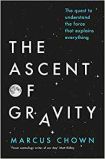

Evidence for gravitational waves was picked up by the LIGO (Laser Interferometer Gravitational-Wave Observatory) in 2015, a hundred years after Einstein predicted their existence. As the book says 'a good case can be made that the discovery of gravitational waves is the most important development in astronomy since the invention of the telescope in 1608'. Why? And why does it matter for the understanding of physics and the universe? Well, Marcus Chown's new book will lead you gently through the background to this discovery and with a small amount of effort on your part you should grasp its relevance.
This is not a book about the LIGO or the process of detecting gravitational waves, though that feat is what made Chown write this book. Instead it's an interested layman's guide to why anyone cared about gravitational waves in the first place, and how our understanding of the universe has changed over the centuries. Gravity is the force most people have heard of, it's the everyday one, and yet there are still major questions to be answered about it and major flaws in our current picture of how it works. Note that I said current picture: Marcus Chown is excellent on bringing out the temporary nature of theories, as well as the messy business of refining them. Science is not the smooth improvement of understanding that many popular science books or school courses would have us believe, it is full of accidental discoveries and there are many big names who either missed some implications of their flash of genius, or refused to believe them. Einstein for instance thought black holes could never exist.
Though the last few chapters by necessity get a bit complicated due to the cutting-edge science they contain, I think the reader has been given enough background at a suitable pace so that they should be able to follow it fairly easily, even if a few sections need a second read. I believe Chown ran the book past his wife, a nurse with no physics background, to check its level as he was writing, and I think that approach has paid off. Given that there is a chapter called Beware the Tides of March, and quotes from the comic fantasy novels of Terry Pratchett and Douglas Adams, you can tell that this book has a fairly light and breezy tone. There are few equations in the main text, some useful analogies, and he is very good at why something is a big deal or a new thing or has repercussions.
My two minor quibbles are endnotes instead of footnotes, and invented scenes. The endnotes are a mixture of references to scientific papers which he needs to give but the reader can safely ignore, and actual explanatory paragraphs that give extra detail. Personally I find it irritating flicking back and forth to see if I need to look at the note or not. The invented scenes are rare, thankfully, and for some readers they will add a touch of human colour but in the vein of dramatic reconstructions on TV they show us Einstein or Newton having their moment of epiphany when in fact we haven't a clue how it happened.
This book will almost certainly leave you more interested in science than you were beforehand, as the enthusiasm is catching. Luckily, Marcus Chown has written plenty of other books so for further well-explained physics you could try We Need to Talk About Kelvin and if you want to broaden into wider scientific fields that touch on everyday life, there's What a Wonderful World What a Wonderful World.
Please share on:  Facebook,
  Twitter and
 Instagram
 You can read more book reviews or buy The Ascent of Gravity by Marcus Chown at Amazon.co.uk Amazon currently charges £2.99 for standard delivery for orders under £20, over which delivery is free. (Paid link)
 You can read more book reviews or buy The Ascent of Gravity by Marcus Chown at Amazon.com. (Paid link)
Comments
Like to comment on this review?
Just send us an email and we'll put the best up on the site.