Difference between revisions of "Levels of Life by Julian Barnes"
(Created page with "{{infobox |title=Levels of Life |author=Julian Barnes |reviewer=John Lloyd |genre=Autobiography |rating=3.5 |buy=Yes |borrow=Yes |isbn=9780099584537 |pages=128 |publisher=Vint...") |
|||
| (2 intermediate revisions by the same user not shown) | |||
| Line 1: | Line 1: | ||
| − | {{ | + | {{infobox1 |
|title=Levels of Life | |title=Levels of Life | ||
|author=Julian Barnes | |author=Julian Barnes | ||
| Line 11: | Line 11: | ||
|publisher=Vintage | |publisher=Vintage | ||
|date=April 2014 | |date=April 2014 | ||
| − | |||
| − | |||
| − | |||
| − | |||
|summary=Powerful writing on grief – albeit of a powerfully affirmative kind – slightly belittled by what comes before it in these three unusually-combined essays. | |summary=Powerful writing on grief – albeit of a powerfully affirmative kind – slightly belittled by what comes before it in these three unusually-combined essays. | ||
| + | |cover=0099584530 | ||
| + | |aznuk=0099584530 | ||
| + | |aznus=0099584530 | ||
}} | }} | ||
I'm sitting here wondering what a graphologist would make of [[:Category:Julian Barnes|Julian Barnes']] signature. Not only is there the slant upwards across the page, there is the fact that the curling forms of his letters take up only a small portion of it, along with what seem errors due to the small size of my autograph book – the wonky horizontal of the J, the apparent hiccup when he put the date of signature down as a very formal part of the exercise. Meeting him (very briefly) and reading several of his novels over the years I formed the impression at least that he was a gentleman in all aspects, intelligent, and handsome on the inside as well as the outside. This melange of writing, both fictional and factual, cannot dissuade me on that – but I think there is a case of the handwriting expert getting a slightly better grasp on the creator, and the reasons for this book being as it is, than I. | I'm sitting here wondering what a graphologist would make of [[:Category:Julian Barnes|Julian Barnes']] signature. Not only is there the slant upwards across the page, there is the fact that the curling forms of his letters take up only a small portion of it, along with what seem errors due to the small size of my autograph book – the wonky horizontal of the J, the apparent hiccup when he put the date of signature down as a very formal part of the exercise. Meeting him (very briefly) and reading several of his novels over the years I formed the impression at least that he was a gentleman in all aspects, intelligent, and handsome on the inside as well as the outside. This melange of writing, both fictional and factual, cannot dissuade me on that – but I think there is a case of the handwriting expert getting a slightly better grasp on the creator, and the reasons for this book being as it is, than I. | ||
| Line 23: | Line 22: | ||
Part two is the faction – taking one of them and sometime balloon passenger Sarah Bernhardt and putting them together in a case of unrequited love. This might have seemed perfectly fine, although I didn't enjoy it knowing what the greater part of the book was going to be – the final panel of the triptych, where Barnes introduces us to his thoughts on grief. His wife, and companion for almost half his life at the time of her death to cancer, is only credited with a forename in the dedication, but she was Pat Kavanagh, literary agent to several esteemed people (I remember Dirk Bogarde dedicating a work to her once he had turned from acting to creating books). | Part two is the faction – taking one of them and sometime balloon passenger Sarah Bernhardt and putting them together in a case of unrequited love. This might have seemed perfectly fine, although I didn't enjoy it knowing what the greater part of the book was going to be – the final panel of the triptych, where Barnes introduces us to his thoughts on grief. His wife, and companion for almost half his life at the time of her death to cancer, is only credited with a forename in the dedication, but she was Pat Kavanagh, literary agent to several esteemed people (I remember Dirk Bogarde dedicating a work to her once he had turned from acting to creating books). | ||
| − | These three sections, with their dimensionally-minded names, work as linked essays, inasmuch as they borrow recurring details, and throughout is the idea Barnes utilises of putting two things together and getting something else. Add the science of photography to the magic of ballooning (or is it the other way round?) and you get the first recorded snapshots of God's eye view on the world. However that idea does not seem to fully work with the third section. It's obvious from the calmly declarative, exceedingly clear and honest writing of the grief section that he saw/sees his marriage as just that – the birth of something greater than the sum of its parts. He even says that ''what is taken away | + | These three sections, with their dimensionally-minded names, work as linked essays, inasmuch as they borrow recurring details, and throughout is the idea Barnes utilises of putting two things together and getting something else. Add the science of photography to the magic of ballooning (or is it the other way round?) and you get the first recorded snapshots of God's eye view on the world. However that idea does not seem to fully work with the third section. It's obvious from the calmly declarative, exceedingly clear and honest writing of the grief section that he saw/sees his marriage as just that – the birth of something greater than the sum of its parts. He even says that ''what is taken away [by death] is greater than the sum of what was there'' and that this is not mathematically possible. This seems wrong, from my limited experience. Isn't it better to think of love as being the mathematically impossible 'one plus one equals one'? |
Barnes comes across as quite an anecdotalist, even if he is mostly concerned with discussing other people's attitude to grief in a clever way of disguising how open he is being about his own. In one thread he talks of people being incomplete and not being able to finish the day, declare this to be this, or so on, without the missing person also knowing what has gone on. This I think is closer to my own opinion – proof that this book, or this essay at least, is definitely one that will rattle around your brain for perhaps too long – and where the 'one plus one equals three' idea is flawed. A loving couple minus half of it is at most a half – but Barnes seemed to say that might be half of three. | Barnes comes across as quite an anecdotalist, even if he is mostly concerned with discussing other people's attitude to grief in a clever way of disguising how open he is being about his own. In one thread he talks of people being incomplete and not being able to finish the day, declare this to be this, or so on, without the missing person also knowing what has gone on. This I think is closer to my own opinion – proof that this book, or this essay at least, is definitely one that will rattle around your brain for perhaps too long – and where the 'one plus one equals three' idea is flawed. A loving couple minus half of it is at most a half – but Barnes seemed to say that might be half of three. | ||
| Line 36: | Line 35: | ||
{{amazontext|amazon=0099584530}} | {{amazontext|amazon=0099584530}} | ||
| + | {{amazonUStext|amazon=0099584530}} | ||
| + | |||
{{commenthead}} | {{commenthead}} | ||
Latest revision as of 13:49, 7 April 2018
| Levels of Life by Julian Barnes | |
|
| |
| Category: Autobiography | |

| |
Reviewer: John Lloyd
 | |
| Summary: Powerful writing on grief – albeit of a powerfully affirmative kind – slightly belittled by what comes before it in these three unusually-combined essays. | |
| Buy? Yes | Borrow? Yes |
| Pages: 128 | Date: April 2014 |
| Publisher: Vintage | |
| ISBN: 9780099584537 | |
|
Share on: | |
|
| |
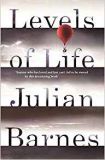

I'm sitting here wondering what a graphologist would make of Julian Barnes' signature. Not only is there the slant upwards across the page, there is the fact that the curling forms of his letters take up only a small portion of it, along with what seem errors due to the small size of my autograph book – the wonky horizontal of the J, the apparent hiccup when he put the date of signature down as a very formal part of the exercise. Meeting him (very briefly) and reading several of his novels over the years I formed the impression at least that he was a gentleman in all aspects, intelligent, and handsome on the inside as well as the outside. This melange of writing, both fictional and factual, cannot dissuade me on that – but I think there is a case of the handwriting expert getting a slightly better grasp on the creator, and the reasons for this book being as it is, than I.
If you read a broadsheet you will know the format of this book from when it came out in hardback – indeed I recognised a great portion of the third part as having been excerpted somewhere. Part one of this triptych is a look back at pioneering aeronauts in hot air balloons – either hydrogen balloons or flame balloons, whatever they are. They may have had crash landings, they may have suffered problems here and there and risked life and limb, but they travelled, they saw the world from unique angles, and almost in homage to Barnes' characters chasing the sun in an airplane in his own book, saw themselves as a photographic negative writ large in shadow form on the tops of clouds.
Part two is the faction – taking one of them and sometime balloon passenger Sarah Bernhardt and putting them together in a case of unrequited love. This might have seemed perfectly fine, although I didn't enjoy it knowing what the greater part of the book was going to be – the final panel of the triptych, where Barnes introduces us to his thoughts on grief. His wife, and companion for almost half his life at the time of her death to cancer, is only credited with a forename in the dedication, but she was Pat Kavanagh, literary agent to several esteemed people (I remember Dirk Bogarde dedicating a work to her once he had turned from acting to creating books).
These three sections, with their dimensionally-minded names, work as linked essays, inasmuch as they borrow recurring details, and throughout is the idea Barnes utilises of putting two things together and getting something else. Add the science of photography to the magic of ballooning (or is it the other way round?) and you get the first recorded snapshots of God's eye view on the world. However that idea does not seem to fully work with the third section. It's obvious from the calmly declarative, exceedingly clear and honest writing of the grief section that he saw/sees his marriage as just that – the birth of something greater than the sum of its parts. He even says that what is taken away [by death] is greater than the sum of what was there and that this is not mathematically possible. This seems wrong, from my limited experience. Isn't it better to think of love as being the mathematically impossible 'one plus one equals one'?
Barnes comes across as quite an anecdotalist, even if he is mostly concerned with discussing other people's attitude to grief in a clever way of disguising how open he is being about his own. In one thread he talks of people being incomplete and not being able to finish the day, declare this to be this, or so on, without the missing person also knowing what has gone on. This I think is closer to my own opinion – proof that this book, or this essay at least, is definitely one that will rattle around your brain for perhaps too long – and where the 'one plus one equals three' idea is flawed. A loving couple minus half of it is at most a half – but Barnes seemed to say that might be half of three.
Perhaps, however, he has been clever enough to build this into the pattern of the book. Just as the three thirds concern the world above us, the world of our level, and the world below our feet, perhaps he has designed the maths too. 1+1=3, 1+1=1+1 (with the failed romance) and then 1+1=1. The point of all this mathematical deliberation is that I just don’t know quite why the first two thirds feature in the book so much. None of the reviews on first publication, even the many five-star ones, convinced me the construction of the book made perfect sense, or hang together in any ideal fashion, and reading it at some remove to reduce prejudice only makes me feel right. I enjoyed the learning I got from the first section, I felt the second completely spurious (was he calling Pat his Sarah Bernhardt?!) – which only leaves me with the third part.
And it is some third part, as if the artist threw all his riches and talents into perhaps the middle panel of the altarpiece. It is an altarpiece in that worship clearly takes its place here – worship of the Patness that Pat brought to the marriage (leaving behind her not so much loneliness as her-lessness). And this is where the heart of the book lies, and where you get the most sense of Julian Barnes himself. And it's where the power of the writing shines, for while this is about grief – unlovable, unsellable grief – it is purely life-affirming. It is also quite adept at making the reader envious. Jealousy, you think, should not come from an outpouring of several years' grief, but what is present throughout is the love that inspired it, and it's frankly something we should all go away and aspire to. Forget unrequited love, and just give a passing glance to the tonic of a hot air balloon ride, but demand the love that earns that grief.
I must thank the publishers for my review copy.
Our reviewer found Hospice Voices: Lessons for Living at the End of Life by Eric Lindner equally inspiring, and non-depressing.
Please share on:  Facebook,
  Twitter and
 Instagram
 You can read more book reviews or buy Levels of Life by Julian Barnes at Amazon.co.uk Amazon currently charges £2.99 for standard delivery for orders under £20, over which delivery is free. (Paid link)
 You can read more book reviews or buy Levels of Life by Julian Barnes at Amazon.com. (Paid link)
Comments
Like to comment on this review?
Just send us an email and we'll put the best up on the site.