Difference between revisions of "The Hidden Fires by Merryn Glover"
(Created page with "{{infobox1 |title=The Hidden Fires |sort=Hidden Fires |author=Merryn Glover |reviewer=Lesley Mason |genre=Travel |summary=An invitation to revisit the Cairngorms, revisit the...") |
|||
| (2 intermediate revisions by the same user not shown) | |||
| Line 10: | Line 10: | ||
|borrow=Yes | |borrow=Yes | ||
|pages=240 | |pages=240 | ||
| − | |publisher= Polygon (An | + | |publisher= Polygon (An Imprint of Birlinn Limited) |
|date=March 2023 | |date=March 2023 | ||
|isbn=978-1846975752 | |isbn=978-1846975752 | ||
| Line 24: | Line 24: | ||
As explained in her introduction, Glover take's Shepherd's chapter titles from her masterpiece The Living Mountain but uses them in a different order to suit her own purpose. The book is hard to categorise definitively. It is part reverence for the work of Shepherd (hardly critique, she's clearly a fan – cards on table so am I), but also partly an endeavour to understand that work more deeply for re-visiting the area so many decades later. For those who don't know Shepherd – go seek her out – she wrote The Living Mountain in the immediate post-war years of the1940s. She did not find a publisher for it, despite being already a reasonably well-regarded novelist. Damning with faint praise there, but I speak of a time when female writers still had to outshine their male counterparts by many parts per million to get the same accolades, possibly even more so in Scotland. We need also to remember that ''nature writing'' wasn't a ''thing'' back then. | As explained in her introduction, Glover take's Shepherd's chapter titles from her masterpiece The Living Mountain but uses them in a different order to suit her own purpose. The book is hard to categorise definitively. It is part reverence for the work of Shepherd (hardly critique, she's clearly a fan – cards on table so am I), but also partly an endeavour to understand that work more deeply for re-visiting the area so many decades later. For those who don't know Shepherd – go seek her out – she wrote The Living Mountain in the immediate post-war years of the1940s. She did not find a publisher for it, despite being already a reasonably well-regarded novelist. Damning with faint praise there, but I speak of a time when female writers still had to outshine their male counterparts by many parts per million to get the same accolades, possibly even more so in Scotland. We need also to remember that ''nature writing'' wasn't a ''thing'' back then. | ||
| − | |||
It became one in the 1970s, which is when Shepherd dusted off her manuscript and found the world waiting for it. It is even more so in need of it now. But I'm not here to talk of Shepherd, but of Glover. It's not possible to disentangle the two, however. In her forward to The Living Mountain, Shepherd talks about the changes the Cairngorms had seen since she wrote it. And Glover is well-placed to both analyse those changes in a wider historical context – going back beyond the 20th century, back to the very birth of the land mass – and then also adding in what has happened in the last few decades. | It became one in the 1970s, which is when Shepherd dusted off her manuscript and found the world waiting for it. It is even more so in need of it now. But I'm not here to talk of Shepherd, but of Glover. It's not possible to disentangle the two, however. In her forward to The Living Mountain, Shepherd talks about the changes the Cairngorms had seen since she wrote it. And Glover is well-placed to both analyse those changes in a wider historical context – going back beyond the 20th century, back to the very birth of the land mass – and then also adding in what has happened in the last few decades. | ||
| Line 53: | Line 52: | ||
{{amazonUStext|amazon=1846975751}} | {{amazonUStext|amazon=1846975751}} | ||
| − | |||
| − | |||
| − | |||
| − | |||
{{commenthead}} | {{commenthead}} | ||
Latest revision as of 10:01, 18 March 2025
| The Hidden Fires by Merryn Glover | |
|
| |
| Category: Travel | |

| |
Reviewer: Lesley Mason
 | |
| Summary: An invitation to revisit the Cairngorms, revisit the work of Nan Shepherd and revisit your own connection with the natural world around you. Well observed, beautifully written, grounded in reality. | |
| Buy? Yes | Borrow? Yes |
| Pages: 240 | Date: March 2023 |
| Publisher: Polygon (An Imprint of Birlinn Limited) | |
| External links: Author's website | |
| ISBN: 978-1846975752 | |
|
Share on: | |
|
| |
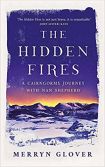

It is always about the book, not the writer, but there are times when the author's hinterland is also the background to the book and so it is necessary to understand that context, in order to appreciate the book. Merryn Glover is of Australian parentage, was born in Kathmandu, grew up in the Annapurna and Himalayan and now lives in Badenoch in Scotland. I can think of no-one better a combination to give us a re-appraisal of Nan Shepherds work than the first Writer in Residence in the Cairngorms National Park. Merryn walks, not so much in the shadow of Shepherd, but in her spirit. I think the two would have gotten along famously.
Glover takes as her premise her own journey in getting to know the Cairngorms, with Shepherd as her guide. Like her fore-runner, she fully admits her limitations, which are all the more comforting given her background. We British like to talk about the weather and about the small inconveniences of life, and sharing this voyage of discovery with an in-comer (hope she doesn't mind me calling her that) I begin to understand why. The mountain range that Glover called her playground as a child did not remotely prepare her for the vagaries of the Scottish ranges with their wayward weather systems and their biting insects. She remarks, as I did not in my own reading, that Shepherd never mentioned that scourge of the hills: the midge. Is that because they have multiplied so much in later years, or climbed into higher reaches on the back of warming weather, or is it just that having just emerged from a world war, Shepherd didn't have thought nor care for a few insect bites?
As explained in her introduction, Glover take's Shepherd's chapter titles from her masterpiece The Living Mountain but uses them in a different order to suit her own purpose. The book is hard to categorise definitively. It is part reverence for the work of Shepherd (hardly critique, she's clearly a fan – cards on table so am I), but also partly an endeavour to understand that work more deeply for re-visiting the area so many decades later. For those who don't know Shepherd – go seek her out – she wrote The Living Mountain in the immediate post-war years of the1940s. She did not find a publisher for it, despite being already a reasonably well-regarded novelist. Damning with faint praise there, but I speak of a time when female writers still had to outshine their male counterparts by many parts per million to get the same accolades, possibly even more so in Scotland. We need also to remember that nature writing wasn't a thing back then.
It became one in the 1970s, which is when Shepherd dusted off her manuscript and found the world waiting for it. It is even more so in need of it now. But I'm not here to talk of Shepherd, but of Glover. It's not possible to disentangle the two, however. In her forward to The Living Mountain, Shepherd talks about the changes the Cairngorms had seen since she wrote it. And Glover is well-placed to both analyse those changes in a wider historical context – going back beyond the 20th century, back to the very birth of the land mass – and then also adding in what has happened in the last few decades.
What I find most interesting here, is that she falls into the same trap that most nature writers do – the one of explaining how dynamic the planet is, how even mountains and continents move, how species come and go – and then wanting to halt that dynamic with the beauty and species range that we have now. And like most nature writers, she doesn't catch herself doing it.
That's my only gripe though. I loved this book. Numerous turned-down corners testify to the number of 'need to think more about this bit' passages. There's not a chapter that I won't be going back to. Anyone who has ever walked in Scotland, even if not specifically in the Cairngorms, will find echoes of their own experiences in her descriptions of weather, of camping, of trudging when it's not fun and bounding when it is. Not sure she uses the term 'bounding' but I'll bet she does it, it shines through in places – that joy of being able to rollop one's way over a landscape that on other days is harder to negotiate.
She talks of walking with her young sons and that reminded me of my own first trip (ill-prepared) on the lower slopes of Ben Nevis, when my parents had the sense to know when to turn back – and my last trip up with my Dad, when we were reckless coming back down.
For me, that is a core skill of this kind of writing. It is not so much the ability to convey her place at her time (that too, obviously) but also the ability to make it more generic, to remind us of our own similar connections with the planet, where- and when-ever we may have had them.
Time and again she comes back to what we don't know about Shepherd: her spiritual beliefs are something she hints at, but very obliquely. Merryn is more open, she comes from a missionary family, but she also gets the Shepherdian idea that communing with nature is as much about the physicality of it, as it is about philosophy or spirituality – indeed I think the two share the notion that the physicality – of the mountain and of the human – are what make all the rest possible.
To take just one example: rain that can be as soft as damp breath or as stinging as needles. If you've been to Scotland for more than a few days, you'll have known both. But then she goes on to contrast this with the cathartic, delirous downpours of Hyderabad – which Scotland is rarely graced with. Glover has Shepherd's way with words.
She is also an equal in pragmatism. She does not romanticise the mountains, but studies to know them as places of living and work and all the conflicts and contradictions that implies. This is crucial in modern nature writing – and if anywhere has shown us all the many ways to get it wrong, the Highlands of Scotland take some beating. A quick synopsis hints at many things that this book does not have space for. I can't help thinking that maybe it did. It is a short book, and a longer edition that allowed Glover space to expound on her take of the history and the future and the possible might not have been a bad thing.
I could go on…she talks about maps, I could talk maps with her for hours! She talks about language and how it hides the history of a place in the names and the shifting of them, and how now maybe they're shifting back again. A throw-away comment led me to thinking about conversations I've been having with my local writing group about names in Norfolk places, hundreds of miles away. Like I said: the skill is rooting the writing very specifically in a time and a place, while at the same time opening it up to other times and places and landscapes and experiences.
Two final thoughts, that really sum up my reading of this book. One obvious one and one less so. Firstly, it has made me want to go back to the works of Shepherd and the story of her life as told in Charlotte Peacock's Into the Mountain which was my introduction to her. All are worth re-reading.
Secondly, and this surprised me because I am called to hills, I am comforted for being among them, but in reading this book what called me wasn't the high places, but the coast. When I put it aside it was to plan trips to my beach hut, and to other beaches. Maybe that is also part of the point – reading about the elemental interaction of one person with one place makes us want to follow suit in our own self and our own (current) place.
To go back to the beginning, check out Charlotte Peacock's brilliant biography of Nan Shepherd Into The Mountain, A Life of Nan Shepherd
Please share on:  Facebook,
  Twitter and
 Instagram
 You can read more book reviews or buy The Hidden Fires by Merryn Glover at Amazon.co.uk Amazon currently charges £2.99 for standard delivery for orders under £20, over which delivery is free. (Paid link)
 You can read more book reviews or buy The Hidden Fires by Merryn Glover at Amazon.com. (Paid link)
Comments
Like to comment on this review?
Just send us an email and we'll put the best up on the site.