The Disappearing Act by Maria Stepanova and Sasha Dugdale (Translator)
| The Disappearing Act by Maria Stepanova and Sasha Dugdale (Translator) | |
|
| |
| Category: Literary Fiction | |

| |
Reviewer: Heather Magee
 | |
| Summary: A haunting reflection on how exile and the weight of history can quietly erode a person's sense of agency and self. | |
| Buy? Yes | Borrow? Yes |
| Pages: 128 | Date: February 2026 |
| Publisher: Fitzcarraldo Editions | |
| ISBN: 978-1804272329 | |
|
Share on: | |
|
| |
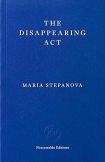

Despite her anonymisation of place names and people, Stepanova's message in this short work of autofiction is unmistakable. A novelist named M travels from B (ostensibly Berlin) to the town of F for a literary festival she is to be a guest speaker at. Detoured by erratic train schedules and nudged by forces beyond her control, her journey slowly bends toward a travelling circus. Swept up in this series of events, M eventually offers to step in for a circus performer who has unexpectedly left the show. The train functions as a motif of transience and impermanence, while the circus embodies the reshaping of identity and a retreat into fantasy, an impulse that lies at the very heart of the novel form itself.
M's final act of agency - her decision to join the circus - is also her only act of agency in this book. From the train schedules ordaining her destiny to M's passive acceptance of her suboptimal situation, lost in an unknown town, she seems to move sedately through life, never choosing her own path, like a dejected, fallen leaf on a powerful stream. In one moment, the grand hotel Petukh was suddenly before her without her making any particular effort to seek it out; in the next, M follows a man from the train without even knowing why.
In other words, the action of the novel occurs largely independently of M. This narrative conceit becomes particularly significant if we take M to be Stepanova herself, relinquishing all narrative control. This subtle framing is hinted at softly throughout: it was as if everything that had already happened meant nothing at all; as if any action could be erased and you could just go back to the beginning. Like a character in a book, M knows that her draft can be rewritten and that she is powerless to such alterations and edits.
This passivity and sense of dissociation, it is suggested, has festered as a result of the wounds of rupture from her birthplace, Russia, and to some extent, her national identity. Russia is never explicitly mentioned in the text, but there are frequent allusions to a beast throughout, a metaphor for Russia's destructive force upon the world and indeed, the course of her own life. The Russian literary critic Alexander Chantsev has referred to a localised historical pessimism which pervades the Russian psyche. I was reminded of this phrase as I read the following: M wasn't sure if it was even the same beast or of a different species , but it operated in a familiar way: it had the same behaviour and diet. The idea of the beast reinventing itself throughout history functions as a metaphor for the iterations that Stepanova has witnessed of Russian history and the cycle of violence which has largely characterised it. The violence of the past is constantly being pasted onto the topology of new eras in Russian history. As Chantsev puts it, this is much like the construction of a new building from rotten planks, [...] the shaping of a new society from old patterns.
In any case, being forced into exile has curtailed Stepanova's agency, and this loss functions as the primary autofictional element. Take the beast, and the war which began because of the beast. There was a time when M was still in charge of her own life, or thought she was. Borgesian ideas of destiny and fate interweave with images of war and territorial expansion. Recalling Borges' poem Chess, where the player is [...] prisoner and the game of war, like chess, is infinite, M herself feels like a piece in a game of chess, entirely at its mercy.
I believe that the key to this novel can be glimpsed through something that M recalls being said to her once about another woman: she's completely lost control over her biography. This phrase made a huge impression on me, as I imagine it did on M, who grinned in response, as if to acknowledge the fact that one needed to keep a tight hold on one's biography, not let it wriggle away and run amok. There is terrible anxiety in this notion, a desperate attempt to impose hindsight on life itself as it unfurls in real time, boundless and furtive, like trying to cage a reckless flame. We see this in the novel in M's feeble self perception as a novelist as she undermines her credentials and casts supreme doubt upon this title (she was a novelist only in name). Within this inner existentialism or self-doubt, emerges a very specific fear which is central to the novel: the fear of losing your grip on narrative, the fear of lack of control over your own identity.
If novels that play with autobiographical elements appeal to you, then almost certainly Thea Lenarduzzi's book, The Tower, with its protagonist named T, will too. I would like to thank Fitzcarraldo for sending a copy of this book to The Bookbag.
Please share on:  Facebook,
  Twitter and
 Instagram
 You can read more book reviews or buy The Disappearing Act by Maria Stepanova and Sasha Dugdale (Translator) at Amazon.co.uk Amazon currently charges £2.99 for standard delivery for orders under £20, over which delivery is free. (Paid link)
 You can read more book reviews or buy The Disappearing Act by Maria Stepanova and Sasha Dugdale (Translator) at Amazon.com. (Paid link)
Comments
Like to comment on this review?
Just send us an email and we'll put the best up on the site.